Opening
Why this matters now
Every husband enters marriage with a working model of family, even if he has never described it. Childhood taught him what conflict sounds like, who handles money, whether affection is spoken, and what happens when someone fails.
Family of origin is influence, not destiny. The point is neither to blame parents for every choice nor to romanticize endurance. It is to bring inherited assumptions into the light so they can be tested instead of obeyed automatically.
This week, identify one pattern to retain and one to replace. Write each as behavior, not a label. Tell your wife only your own findings; she may decline to participate.
Session video on the family you brought into the marriage.
Scripture anchor
Ground your work in Scripture
Read each passage in its wider context before applying it. Check each one as you read it.
This week
Your tasks
Work through these in order. Each task has an observable finish line.

Leaving as an emotional shift, inherited conflict styles, and a critical panel on when advice is not enough.
Task 1
Observe your family-of-origin patterns
Actions
- Describe who made decisions in your home growing up, and how.
- Note whether apologies were common, rare, or demanded only from children.
- Ask what rule about men, emotion, money, conflict, or loyalty your childhood taught.
- Describe patterns and effects; do not put relatives on trial.
Task 2
Notice present triggers
Making sense of a reaction is not the same as being right for this marriage.
Actions
- Identify one ordinary marital moment that produces a reaction larger than the event.
- Ask: "What old rule does this moment activate?"
- Create a small gap between sensation and action before you respond.
- Do not weaponize background: "You are acting just like your mother" rarely creates understanding.
Task 3
Retain one gift intentionally
Actions
- Name one inherited strength that actually serves your marriage now.
- Ask your wife whether she experiences it as a gift; she may see it differently.
- Even virtues can distort: loyalty can become secrecy, thrift can become control.
- Retaining a pattern intentionally is different from repeating it unconsciously.
Task 4
Replace one harmful pattern
Actions
- Choose one specific behavior, not your entire family system.
- Identify the cue that usually activates the old pattern.
- Write one replacement response that can be observed: "I need twenty minutes and will return at 7:40."
- Practice the replacement once when the cue appears, or rehearse it calmly if it does not.
Trauma and abuse histories
Do not demand disclosure, contact with relatives, or reconciliation. Past harm may explain present protection, but it never excuses current coercion or violence. Qualified trauma-informed care may be essential.
Private self-check
Reflect alone, then check each one off. Do not use these to diagnose or score your wife.
Deep-dive audio on forgiveness that does not require unsafe contact.
Required action
Retain one pattern and replace one pattern
Observable finish line: You named one pattern to retain, one to replace, and carried out or rehearsed the replacement without assigning homework to your wife.
Optional conversation guide
Share your own findings first. Your wife may decline, correct your interpretation, or stop the conversation.
Study library
More study aids
Optional extras beyond the media woven into the lesson above; go deeper if you want to.
Watch
Short video overviews.
Video
Family Dynamics in Marriage
WatchHow inherited patterns show up in a marriage nobody planned them for.
Listen
Audio briefings for deeper reflection.
Audio
Where This Session Needs Care
ListenCritical audio on the limits of a formation course around trauma. Read against the module caution.
Slide decks
PDF study decks.
Navigating Family Legacies
Open slide deckLeaving, cleaving, and the new centre of gravity.
The Marital Blueprint
Open slide deckSession overview deck.
Study graphics
Single-page visual summaries.
Study graphics
Navigating Family Patterns in Marriage
View graphic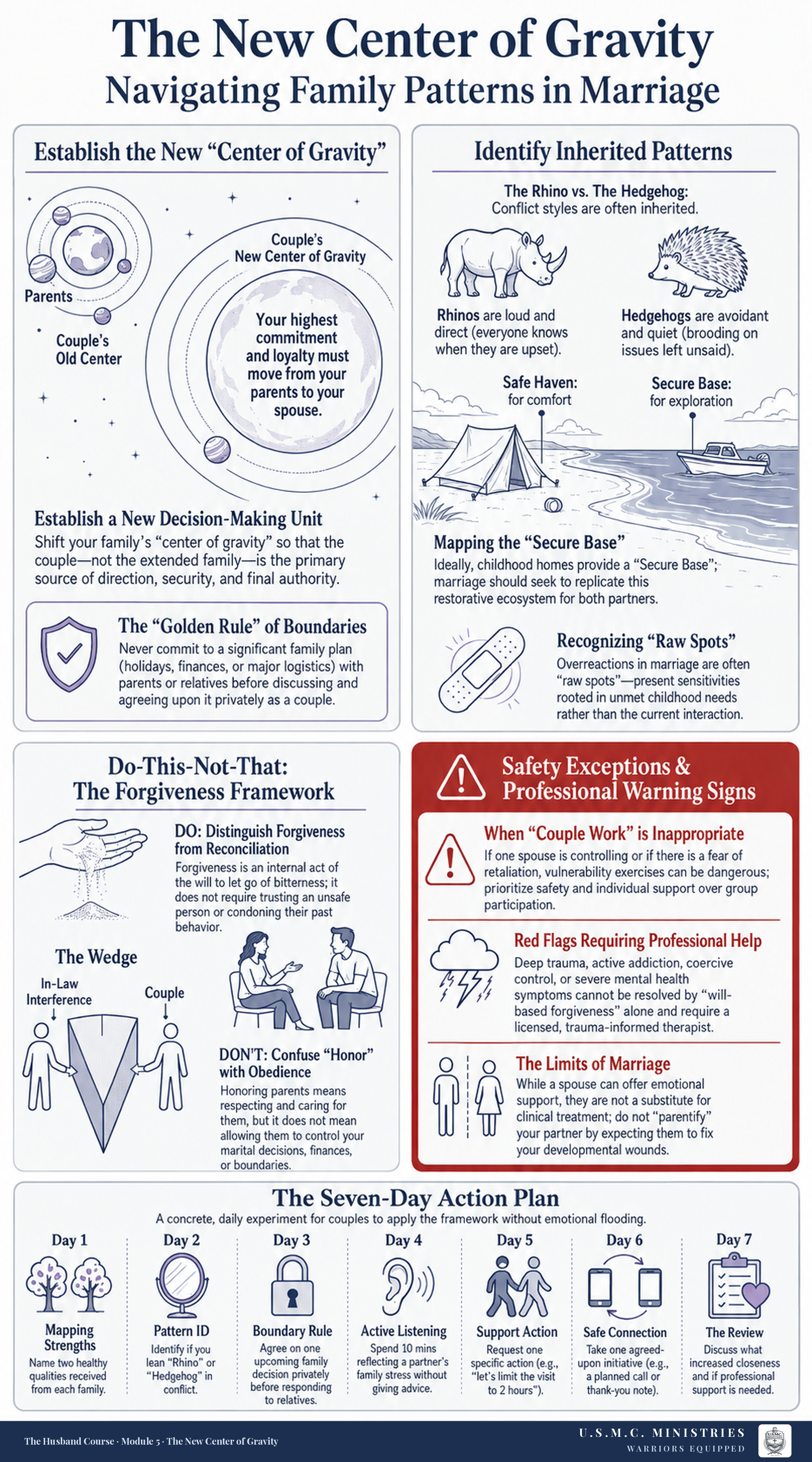
Companion guide on inherited patterns and boundaries.
Read
Study reports as clean, printable PDFs.
Read
The Impact of Family: Past and Present
Read the reportExecutive briefing; best starting point for this module.
Read
The Ghost at the Dinner Table
Read the reportLonger treatment of in-law dynamics and inherited expectations.
Read
Why Your In-Laws Are Living in Your Marriage
Read the reportPopular-article register; the headline overclaims; use as a prompt.
Optional companion journal
Optional written exercises. This module works without it.
The Marriage Course Study JournalAffiliate disclosure: Amazon Associates link. As an Amazon Associate I earn from qualifying purchases, at no extra cost to you.
Drill first
Flashcards
59 cards from the Module 5 study material. Read the prompt, answer it in your head, then reveal. Mark a card known when you can answer it without help; the deck remembers on this device.
Card 1 of 59
Last step before you close the module
Knowledge check
Take this after the tasks, the required action, and the flashcards. 10 questions; each answer explains itself, right or wrong. Your answers stay on this device.
Complete module 5
Mark complete only after the field-action finish line. You can change this later.
0 of 0 checks complete · 0 sec logged across the course.